The importance of art in child development

A series of articles by our guest blogger, Janine Georgiou-Z about the importance of art and creative development in babies, toddlers and children. She will also add some ideas to do art with your toddler at home.

30 Things to do this winter

I love the lists of important stuff to do with your kids during every season. I found many kinds online and decided it would be fun to make our own! So together with Connie we compiled a fun list of activities to do this winter. Technically, the winter just begun a few days ago, so here it comes!

Guest blog: Healthline.com. Choosing the diet that is right for you

Looking for the ideal diet? There is actually no "right answer" for everyone, and dieting has to be a very personalized matter. What works for the woman next door may not work for you and this is especially true where any dieting and weight loss are the focus.

5 minutes of beauty in 5 easy steps

I needed to figure out a way to look and feel good about myself when leaving the house with a total of about 5-7 minutes of prep time! (the amount of time I could keep Aud busy in her crib with a book or stuffed animal). I think I’ve mastered it so I thought I would share with you how I do it!

Sensory fun at home! Easy, fun, great activity for a toddler.

Santino's sensorial activities have been mostly tactile these days, with a few occasional auditory, visual, and thermic. I haven't been documenting much of these other experiments, but he has learned to discriminate by size, length, weight, loudness, color, even edibility.

Showing posts with label language. Show all posts

Wednesday, January 2, 2013

Practicing fine motor skills. Playing with tongs.

Santino's favorite utensil actually has a much greater purpose, other then just distracting him when I'm washing dishes or cooking. Tongs help children to work on the grip of their hands and fingers, preparing them for writing.


I found this great article here (click), giving a few great suggestions to promote development of the fine motor skills. Santino always loved playing with tongs, snapping them like crocodiles, but now I was able to actually put this utensil to a good use.

I started giving Pipidinko small and light large objects to pick up with the tongs. Yesterday we picked up and sorted chickpeas and beads. I reminded him that these are "chickpeas and beads" both in English and in Russian.
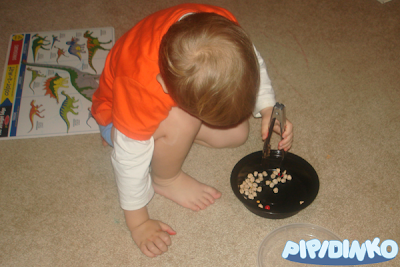


He picked up plastic containers, after he practiced opening them.


Today he enjoyed playing with the wooden blocks. I suggested building a tower with the tongs. He loved this idea! And once he was finished, he wanted to do it again and again!


I gave him an empty eggs container (actually, only a half, as it was a leftover from another project) and 5 small onions to pick up with the tongs and put in the egg slots. He also learned "onion" and "slots", again in both languages.


Once he was done, he wanted to take them out, again, with the tongs.
 

I noticed he often switches hands, and doesn't always stick to the right hand, not only when playing with tongs, but also when drawing and painting. Often he would take 2 paint brushes and will paint with both at the same time.

To summarize, I loved these activities! I can see Pipidinko doing this every day, picking up more fun stuff, practicing, concentrating and just simply enjoying himself!

Wednesday, August 1, 2012

Bringing up a bilingual child

  I speak Russian and English, my husband speaks English. Since even before Santino was born, I've been researching best practices on how to bring up a multi-lingual child, hoping he would get the best out of both languages and both worlds. I realize that he most probably won't be a fluent Russian language speaker, but I would love for him to be able to read and understand the literature.

I read somewhere that bilingual children start speaking later, although 2 languages simultaneously. I was prepared for Santino to start speaking after 2 years old. Luckily, he started speaking way before. He is picking up on both languages successfully, being more comfortable with English at this time. I worried before, didn't want him to have any preference in language, but later on I relaxed and let him pick up any language he wants, trying to tag the second one along. Santino prefers English words at this time, and I am not surprised, 90% of words he comes in contact with right now are easier to pronounce in English, but he did pick up some Russian words as well.

While Santino is not putting words in long sentences yet, he picks up more and more words every day, he responds to both languages and points at the pictures when I ask him in either language.

I got lucky, after being the only constant Russian-speaking person in his life (my parents live far away and only get to talk to him once in a while via Google video conference), I met a Russian-speaking family, living in my neighborhood and (yay!) also with a 2 years old boy. I encourage Santino hang out more with them, to hear more of the language and to have more practice speaking it. I hope these little boys can grow up being close friends.

Anyways, back to my teaching strategy. Here is what I've been doing, some tips that I learned on the way, and a start to a conversation on this topic. Please, do pitch in!

1. Being not a talker by nature, I found it very difficult to "talk as much as possible" to my son, especially in the beginning, when he was not as responsive and sleeping most of the time. I couldn't just talk, so I sang. I sang almost non-stop, while washing dishes, while breastfeeding, while walking baby in a stroller. I sang mostly in Russian, and when I didn't sing, I played those songs for him on a radio. I don't know what that did for his language skills, but I hope it gave Santino the feeling of the flow of the language, recognition of the sound.

2. When he grew up a little, I actually started forcing myself to talk more and more, and while I still wasn't able to talk about various things, I decided I can talk about the same thing over and over, only now in 2 languages. So I started commenting on Santino's moves, on the things around us in 2 languages. And when I didn't know what to say, I would repeat the same thing. Repetition is good, right?

3. I tried making flash cards with written Russian words (according to Doman, it was supposed to help Santino learn how to recognize written words), but found that I often couldn't get him concentrate on these cards, he didn't like to be disturbed if he was playing with a truck or a ball. I also kept mixing them up, losing, and in general they were in my way. I adjusted this idea, and created these cards in PowerPoint. Words, numbers, letters, flags, shapes, etc. Pictures were accompanied with the words and my voice recording would clearly say what was shown on the screen. I also added some Mozart music in the background. I heard, that Mozart music promotes memory and concentration, and all and all, is very beneficial for everybody.

So I started to show these flashcards to Santino several times a day, every day for several months, and he suddenly started not only recognize them, but also make an effort to pronounce whatever he hears. I think my voice, Mozart music and repetition really did help Santino to get a push and start trying to say the words out loud.

He still doesn't repeat everything I ask him to (the hardest part for me, is to have him say "thank you" and "please"), but he is much more responsive now, he understands both languages and he loves repeating both of them!

Please do comment and share your experiences teaching your child how to speak and understand in one, two or however many languages.

Nataliya